
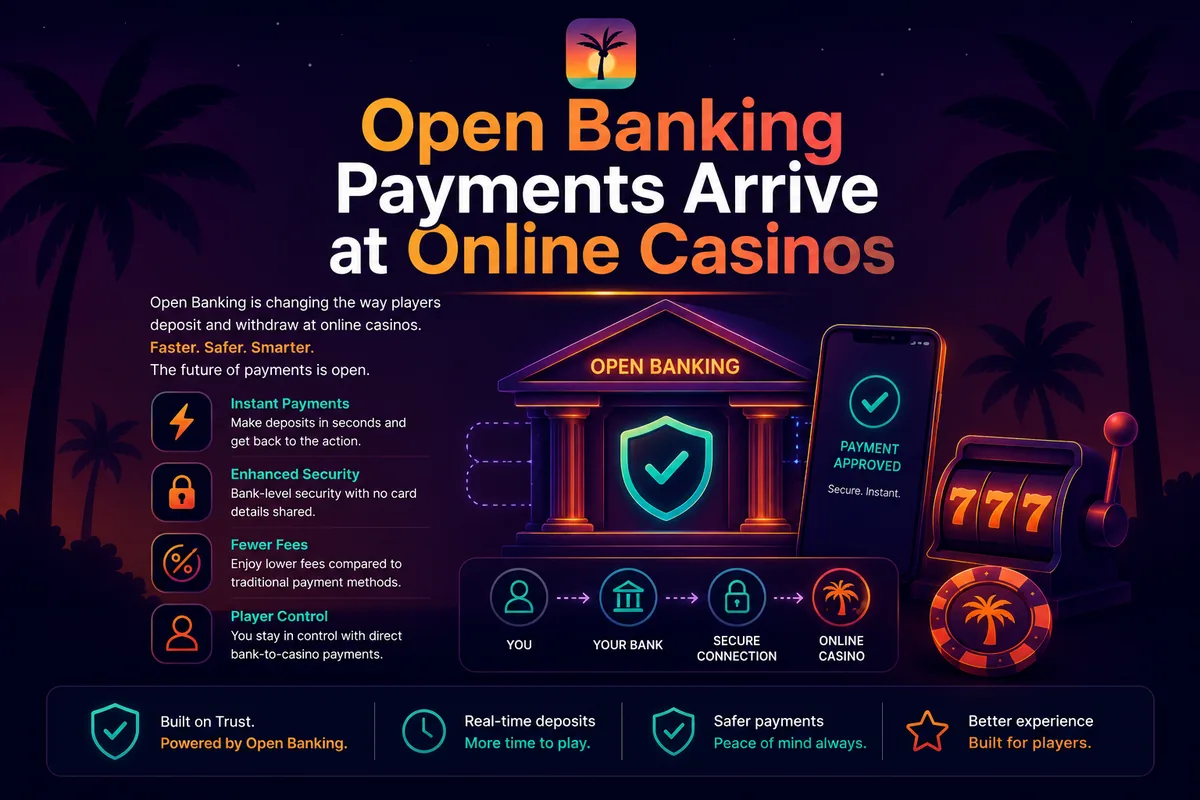
What open banking actually is
Strip away the branding and open banking is a simple idea. Instead of typing a card number into a casino cashier, you pick your bank from a list, log in through your own banking app or portal, approve the exact amount, and the money moves straight from your account to the casino's. No card in the middle. This is what the industry calls account-to-account, or A2A, and pay-by-bank is just the consumer-facing name for it.
The plumbing behind it is regulated. In Europe and the UK the legal backbone is PSD2, the second Payment Services Directive, which forced banks to open secure programming interfaces so licensed third parties could initiate a payment on your instruction. That "on your instruction" part matters. The provider never sees your banking password; you authenticate inside your own bank's app, usually with a fingerprint, face scan or a code, and the bank confirms the payment back down the chain. Strong customer authentication, the two-factor step you now take for granted, is a PSD2 requirement rather than a nice-to-have.
Other regions run similar frameworks under different names. Brazil built Pix as a central-bank instant-payment scheme. India has UPI. Australia has the New Payments Platform sitting behind its own A2A services. The details differ, but the shape is the same everywhere: a regulated, real-time push of money from your account, authenticated by you, with no card network taking a cut in the middle. When a cashier offers "pay by bank", that is the family of rails it is tapping into.
The rails you will recognise
You will rarely see the words "open banking" on a deposit screen. You will see a provider logo, and which one depends heavily on where you play. It helps to know the names, because they behave slightly differently and a couple of them carry a reputation worth knowing about.
Trustly is the one most casino players in Europe run into first. It sits on top of open banking rails across a long list of countries and handles both the deposit and, importantly, the payout back to the same account. In the Netherlands, iDEAL is the default way a huge share of people pay for anything online, casinos included, and it is bank-to-bank at its core. UK open banking, built on the same PSD2 foundations, powers a growing set of pay-by-bank options at British-facing sites. Brazilian players will see Pix almost everywhere, often as the single fastest method on the page.
You may also remember POLi, the Australian and New Zealand bank-transfer service that shut down. It is worth naming because the gap it left has been filled by newer A2A providers built on the country's modern payment platform, and you will sometimes see them pitched as the "POLi replacement". We would not over-claim any single brand as universal. The point is that pay-by-bank is not one company. It is a category, and the logo you tap is a regional front door onto the same underlying idea.
Why casinos are pushing it
Follow the incentives and the enthusiasm makes sense. The first driver is cost. Card deposits carry interchange and scheme fees that a bank transfer largely sidesteps, so on a busy cashier the saving adds up fast. Operators do not always pass that saving to you, but it is real, and it is why the pay-by-bank button keeps drifting to the top of the list.
The second driver is fraud, and this is the big one. A card payment can be disputed and clawed back through a chargeback weeks after the fact. An authenticated bank push is far harder to reverse, because you approved it inside your own bank with strong authentication. For a casino, that turns a category of chargeback abuse, depositing, playing, then disputing the charge, into something close to impossible. Fewer reversals means fewer losses and, over time, a lower risk profile with their own payment partners.
The third driver is compliance, and it is quietly the most interesting. Because the payment comes from a named bank account that the bank has already identity-checked, a lot of know-your-customer work gets easier. The name on the account, the fact that it is a real verified account, and in some flows the ability to confirm you are the account holder, all feed straight into the anti-money-laundering checks a licensed operator has to run anyway. KYC and identity are, to a degree, baked into the rail. That does not remove a casino's own verification duties, but it smooths them.
Why a lot of players like it
We test this stuff with our own money across nine markets, and the appeal from the player side is easy to state. You never hand your card details to the casino. The card number, the expiry, the security code, none of it touches the operator's systems, because the payment is authorised inside your bank. For anyone nervous about a gambling site holding their card on file, that alone sells it.
Speed is the second draw. A well-built pay-by-bank deposit lands in the account instantly or within a minute, which is no better than a card feels but no worse either. Where it can genuinely win is on the way out, because a payout can be pushed back to the same verified account without waiting on card-scheme settlement windows. We have timed Trustly and iDEAL withdrawals that cleared inside a couple of hours, well ahead of the two-to-five working days a card refund routinely takes.
Then there is the quieter benefit: fewer failed deposits. Card payments for gambling get declined by issuers surprisingly often, sometimes as a blanket policy, sometimes as a fraud-rule false positive. A bank push that you authorise yourself does not trip those merchant-category blocks the same way. For players who have watched a card get refused at the cashier for no obvious reason, that reliability is worth a lot.
Open banking vs cards vs e-wallets
No method wins on every axis, and anyone who tells you otherwise is selling something. Here is how the three broad families stack up on the things that actually decide the experience: how fast money moves, what it costs, whether you can claw a payment back, and how much of your data the casino ends up holding.
| Factor | Open banking (pay-by-bank) | Debit card | E-wallet (PayPal, Skrill, etc.) |
|---|---|---|---|
| Deposit speed | Instant to about a minute | Instant | Instant |
| Withdrawal speed | Often same day, sometimes hours | 2 to 5 working days | Hours to 1 day |
| Typical fees to player | Usually none | Usually none, some card surcharges | Possible wallet or FX fees |
| Chargeback / dispute route | None in the card sense, limited recourse | Full chargeback rights via scheme | Wallet dispute process, varies |
| Card details shared with casino | None, you authorise in your bank | Full card number on file | None, wallet sits in between |
| Reversibility if you regret it | Generally no, authenticated push | Sometimes, via issuer | Limited, wallet dependent |
| Identity / KYC handling | Bank has already verified you | Separate casino KYC | Wallet KYC plus casino KYC |
Read that table and the trade-off jumps out. Open banking is fast, cheap and private, and it hands you almost no way to reverse a payment after the fact. A debit card is the slowest to pay out and the least private, and it is the only method here that gives you real chargeback rights through the card scheme. E-wallets sit in the middle, adding a privacy buffer and quick payouts but sometimes their own fees. Which one is "best" depends entirely on which of those columns you care about most.
Deposits and withdrawals: the timing gap
People obsess over deposit speed and it barely matters, because almost every modern method deposits instantly. The number that actually shapes your experience is the withdrawal time, and that is where the methods spread out. We time every payout we can on the desk, and the pattern below matches what we see run after run.
| Method | Deposit timing | Withdrawal timing (after casino approval) | Notes |
|---|---|---|---|
| Open banking / pay-by-bank | Instant to 1 min | Same day, often 1 to 4 hours | Paid back to the verified account you deposited from |
| Trustly / iDEAL A2A | Instant | A few hours to same day | Deposit and payout run on one rail |
| Debit card | Instant | 2 to 5 working days | Bound by card-scheme refund windows |
| E-wallet | Instant | A few hours to 24 hours | Fast to the wallet, then a separate step to your bank |
| Bank wire (manual) | Same day to 2 days | 1 to 3 working days | Slowest end to end, still used for large sums |
| Crypto | Minutes | Minutes to hours | Fast, but off-topic here and volatile in value |
One caveat we repeat until people are sick of it: the "after casino approval" column is doing a lot of work. None of these timings start until the operator has finished its own withdrawal review, and that review, not the payment rail, is where slow payouts actually come from. A pay-by-bank withdrawal that clears in two hours once approved is worthless if the casino sits on the approval for three days first. The rail is fast. The house is the variable.
The catch: no chargeback, no friction
Now the part the deposit screen never mentions. The same feature that makes casinos love open banking, that an authorised bank push is hard to reverse, is the exact thing that removes a protection you may be relying on without knowing it. With a card, a genuinely disputed charge can go through a chargeback. With an authenticated A2A payment, that route mostly does not exist. You approved it, your bank confirmed it, the money is gone. For a normal deposit that is fine. In a dispute with an operator over a payment you did not intend, it leaves you with far less leverage.
The second problem is friction, or the lack of it. A card deposit has a couple of small speed bumps: fetching the card, keying the number, the occasional decline. Those bumps are annoying, and they are also tiny moments where an impulse can break. Pay-by-bank sands them off. Pick bank, tap approve, done, and it can be done again thirty seconds later. Instant, frictionless top-ups are wonderful when you are in control and quietly dangerous when you are chasing a loss at eleven at night. The rail does not care which of those you are doing.
Third, reversibility runs one way. Deposit fast, yes. But if you fund an account in a moment you later regret, there is generally no undo button, no issuer to call, no "I want that back" that works the way a card dispute sometimes does. Treat every pay-by-bank deposit as final at the moment you approve it, because for practical purposes it is.
Using pay-by-bank without getting burned
We are not anti open banking. We use it ourselves and rate it highly for speed and privacy. The trick is to get its benefits while replacing, deliberately, the safety rails it strips out. Here is how we actually play it.
Put the friction back on purpose
The single most useful move is to set a deposit limit inside the casino before you play, not after. Every UKGC, MGA and comparable licensed site offers daily, weekly and monthly deposit caps in the account settings, and they are the one control the frictionless rail cannot talk you out of once it is set. Pick a weekly number you would be genuinely fine losing, set it low, and make the casino, not your willpower, enforce it. A cooling-off period on limit increases means the number cannot be raised in the heat of a session.
Keep the rail honest with a separate account
Because pay-by-bank pulls straight from whichever account you authenticate, we keep gambling money in a dedicated account with a fixed, modest balance, and pay from that. When it is empty, the session is over, and there is no card to fall back on. It is a crude control and it works precisely because it is crude. The rail can only push what is there.
Do not use it to dodge your own blocks
If you have set a limit, taken a break, or self-excluded, the answer is never a different payment method. A2A speed makes it easy to reopen the tap, and that is the moment to close the laptop instead. Anyone who feels the pull to route around their own controls should look at the tools on our responsible gambling page and, in the UK, at GamStop. This is an 18-plus activity, it should stay fun, and if it stops being fun the fastest deposit method in the world is a problem rather than a feature.
Our read
Open banking at online casinos is, on balance, a good thing that arrived with a warning label nobody printed. The privacy is real: your card details never sit on a gambling operator's servers. The payouts are genuinely quicker than card refunds once an operator approves them. The lower fees and higher deposit success rates are nice bonuses. For a disciplined player who already sets limits, we would happily recommend it over a card in most markets.
The warning label is the loss of the card chargeback and the loss of friction. Those are not small. A card gives you a slow, clumsy, protected way to move money. Open banking gives you a fast, clean, largely irreversible one. If you are the kind of player who has ever felt relief that a card got declined at the wrong moment, understand that pay-by-bank removes that accidental brake, and put a deliberate one back with a deposit limit.
Our position from a desk that opens its own accounts and times its own withdrawals: use pay-by-bank for the speed and the privacy, treat every deposit as final the second you approve it, and never let a frictionless rail become the reason a session runs longer than you planned. The technology is not the risk. Using it without the guardrails it quietly removed is. Set the limit first, then enjoy the fast payout.
FAQ
What is open banking or pay-by-bank at a casino?
It is a way to deposit by moving money straight from your bank account to the casino, with no card in between. You pick your bank, log in through your own banking app, and approve the amount. The industry calls it account-to-account, or A2A. In Europe and the UK it runs on regulated rails set up under PSD2, and providers like Trustly, iDEAL and various UK open banking services are all versions of the same idea.
Is it safe to pay a casino directly from my bank?
The payment itself is secure. You authenticate inside your own bank with strong customer authentication, the provider never sees your banking password, and the casino never gets your card details. The safety question is not the technology, it is the loss of a card chargeback and the ease of depositing again. It is safe as a payment; the risk is behavioural, so set a deposit limit before you use it.
Can I get a chargeback on an open banking deposit?
Generally no, not in the way a card allows. Because you authorised the payment inside your own bank, it is treated as a push you consented to and is very hard to reverse. That is exactly why casinos favour it. If you are relying on the ability to dispute and claw back a gambling payment, a card keeps that option and pay-by-bank largely does not.
Are open banking withdrawals faster than card payouts?
Usually, yes, once the casino approves the payout. A2A payouts are often paid back to your verified account within hours, while card refunds are bound by scheme windows of two to five working days. The catch is that no withdrawal timing starts until the operator finishes its own review, and a slow operator can wipe out the rail's speed advantage entirely.
Does pay-by-bank still require KYC and ID checks?
It reduces the friction but does not remove the duty. Because the payment comes from a bank account the bank has already identity-verified, some of the know-your-customer groundwork is effectively done, and the name on the account feeds straight into a casino's anti-money-laundering checks. A licensed operator still has its own verification obligations, so you may still be asked for documents at some point, usually before a large withdrawal.
How do I keep instant deposits from hurting my bankroll?
Put the friction back deliberately. Set a weekly deposit limit in the casino before you play, choose a number you would be fine losing, and let the limit rather than your willpower do the enforcing. Many players also pay from a separate account holding only their gambling money, so an empty balance ends the session. Never switch payment method to dodge a limit or a self-exclusion. This is 18-plus entertainment, and the tools on our responsible gambling page and GamStop exist for exactly this.