
What actually changed on 1 January 2025
For years Brazil was the biggest grey market on the planet. A 2018 law legalised fixed-odds betting in principle, then nothing happened for half a decade while the rules sat unwritten. Offshore operators poured in, advertised on football shirts, and paid no Brazilian tax. That era ended on the first day of 2025, when the federal regime finally switched on under the Ministry of Finance and its dedicated body, the Secretaria de Prêmios e Apostas, the SPA.
The scope is the part people outside Brazil tend to get wrong. This is not just sports betting. The law covers "apostas de quota fixa", fixed-odds betting, and the SPA read that to include online casino games, so slots, live dealer and the rest sit inside the same authorisation as your football accumulator. One licence, both products. That single decision is why Brazil went, overnight, from a legal vacuum to one of the larger regulated iGaming markets in the world.
The other thing that changed was accountability. A licensed operator now has a Brazilian legal entity, a local responsible person, servers and data obligations inside the country, and a regulator that can pull the plug. If a payout goes wrong at a .bet.br site, there is finally somewhere to complain that is not a support inbox in another hemisphere. That is the whole point of what the SPA built, and the first year was mostly about making it real rather than theoretical.
The licence model and the fee
The model is federal and it is deliberately expensive. An operator applies to the SPA for a five-year authorisation, and the headline cost is a fixed licence fee reported at around 30 million reais. That is not a rolling percentage, it is a flat entry ticket, and it was set high on purpose. The government wanted serious, capitalised operators, not a long tail of thinly funded sites, and a fee of that size does a lot of filtering before anyone reviews a single document.
What you get for the fee is the useful bit. One authorisation lets an operator run up to three brands, each on its own domain. So a single licensed company might front a sportsbook brand, a casino brand and a combined brand, all three legally covered, all three required to sit on the mandatory address format we will get to next. When you see three different-looking .bet.br sites that share a payments backend and a support script, that is usually one licence and three permitted brands, not three separate approvals.
| Element | How it works under the SPA regime |
|---|---|
| Regulator | Ministry of Finance, via the Secretaria de Prêmios e Apostas (SPA) |
| Authorisation term | Five years, renewable |
| Licence fee | Fixed one-off, reported around 30 million reais (approx.) |
| Brands per licence | Up to three, each on its own domain |
| Product scope | Fixed-odds sports betting and online casino, together |
| Local presence | Brazilian entity and responsible person required |
| Domain | Mandatory .bet.br address |
Numbers here are reported and approximate, and the fee has been quoted slightly differently across sources, but the structure is stable: one big flat fee, five years, three brands. If you ever see a Brazilian site claiming to be "licensed" while charging into a fourth or fifth brand under one authorisation, treat the claim with suspicion. The three-brand ceiling is one of the cleaner tells in the whole system.
The .bet.br rule and how to read it
This is the single most player-friendly design choice in the entire regime, and it costs nothing to use. Every licensed operator must run its Brazilian-facing site on a .bet.br domain. Not .com, not .bet, not a .br subdomain of something else. The address itself is the licence badge. If a betting or casino site serving Brazilian players does not end in .bet.br, it is by definition outside the SPA system, full stop.
We cannot overstate how much simpler this makes life for a player. In most regulated markets you check a licence by hunting for a registration number in the footer and then cross-referencing a regulator database that half the audience never opens. In Brazil the first, cheapest check is in the browser bar. Read the domain. If it does not end in .bet.br, stop there. It is the rare piece of gambling regulation that put the safety signal where people actually look.
| Check | Licensed .bet.br operator | Unlicensed / offshore site |
|---|---|---|
| Domain ending | Ends in .bet.br, always | .com, .bet, .net or a lookalike |
| Padlock and address | Valid HTTPS, domain matches the brand | Often a near-copy of a real .bet.br name |
| Regulator reference | SPA authorisation cited, entity named | Curacao or no licence, no Brazilian entity |
| Payments | Pix via a Brazilian PSP, CPF-matched | Pix to a random third-party CPF, or crypto only |
| Responsible-gambling tools | Limits, self-exclusion, 18+ notices | Absent or cosmetic |
| Ads and sponsorship | Carries mandated warnings | Aggressive, "no limits", no warnings |
One warning about the rule's own success: because .bet.br now signals safety, unlicensed sites imitate it. We have seen lookalike domains that bury a real-looking string near the end while the actual address is something else entirely. So read the true end of the domain, the part immediately before the first slash, not a fragment planted mid-URL. The rule is excellent. Fraudsters know it is excellent, which is exactly why they copy it.
Pix, and why it runs the whole market
You cannot understand Brazilian iGaming without understanding Pix. It is the central bank's instant payment rail, it is free for individuals, it settles in seconds at any hour, and essentially every adult with a bank account uses it. When the regulated market opened, Pix was not one option among many. It was the option. Deposits land instantly, and withdrawals, when the operator plays fair, can be back in your account in minutes rather than the days a card or bank transfer would take elsewhere.
The regulator leaned into that. A cornerstone rule is that the account funding a bet and the account receiving a withdrawal must belong to the same registered player, matched to their CPF, the Brazilian tax ID. No paying in from one person's Pix and cashing out to another. That kills a whole category of money-laundering and account-selling, and for an ordinary player it means the safety instruction is blunt and simple: your deposits and your withdrawals should always move through a Pix key tied to your own CPF. If a site ever asks you to pay a random individual's Pix key, that is not a licensed operator, that is a scam wearing the costume of one.
| Method | Typical deposit speed | Typical withdrawal speed | Notes |
|---|---|---|---|
| Pix | Instant | Minutes to a few hours | The default; must be CPF-matched to you |
| Bank transfer (TED) | Same day | 1 business day | Rare now that Pix exists; bank hours apply |
| Debit / credit card | Instant to minutes | Often not supported for payout | Card cash-outs are limited; expect Pix back |
| E-wallet | Instant | Varies | Less common on .bet.br sites than offshore |
| Crypto | Minutes | Minutes | A red flag on a supposedly licensed site; not the regulated norm |
A quick worked example from our own testing pattern. We deposit 100 reais by Pix, and it is playable before the confirmation screen finishes loading. We play, we request 150 reais out, and on the better .bet.br operators the money is back in the same account inside the hour, no card, no third party, same CPF start to finish. That round trip is the single cleanest thing about the Brazilian market. When it does not happen that way, the operator, not the rail, is the problem.
Advertising and responsible gambling
Anyone who watched Brazilian football before 2025 remembers the wall of betting logos. The regime did not ban that, but it fenced it. Licensed operators can advertise, but the ads must carry responsible-gambling messaging, cannot target minors, cannot promise guaranteed or risk-free returns, and are bound by time and content restrictions the SPA can tighten. The blunt "bet now, win big" energy of the grey years is not compliant any more, at least not on a licensed site.
On the product side, every .bet.br operator has to offer the responsible-gambling toolkit: deposit and loss limits you set yourself, time-out and cooling-off options, and self-exclusion. There is an 18+ minimum, verified against the same CPF identity check that underpins the payments rule, so age and identity are checked together rather than as an afterthought. Self-exclusion is meant to hold across the licensed system, which is a meaningful protection if it is enforced consistently, and enforcement consistency is one of the things year two will test.
We will be honest about the limit of all this. Rules on paper are only as good as the audits behind them, and a first-year market is still finding its enforcement rhythm. But the direction is right, and the contrast with an offshore site is stark: the licensed operator has to give you the brakes and has to show you the warnings, while the offshore one has every incentive to hide both. If you gamble in Brazil, the responsible-gambling tools are there for a reason. Set the deposit limit before you need it, not after.
The crackdown on unlicensed sites
A licence system means nothing if the unlicensed sites keep operating next door, so the enforcement side arrived alongside the licences. The SPA published lists of authorised operators and moved to block the rest, and the mechanism that gave the blocking teeth was payments. Cutting an unlicensed site off from Pix and from Brazilian banking is far more effective than trying to block a domain that can move to a new address overnight. Choke the money and the site withers whether or not the URL still resolves.
Through 2025 that meant waves of domain blocks and, more importantly, pressure on payment providers to stop processing for sites outside the .bet.br system. It is not airtight. Determined operators reappear under fresh names, and some players still find their way to them. But the friction is real now in a way it simply was not before, and for the ordinary player the takeaway is clean: a site that suddenly cannot take your Pix, or asks you to route money through some workaround, is very likely one the system is trying to shut out. That is not a bug to route around, it is a warning.
Tax on operators and on your winnings
Two tax questions matter here, and people mix them up constantly. The first is operator tax. Licensed operators pay a levy on gross gaming revenue, reported around 12 percent, with further contributions layered on top that push the effective burden higher, plus ordinary corporate taxes. That is a heavy load, and it is one reason the licence fee filters for well-capitalised companies. A thinly funded operator cannot survive both the 30 million entry fee and a GGR levy of that size.
The second question is the one players actually ask: do I pay tax on my winnings? The framework provides for taxation of player prizes above an exemption threshold, aligned with the income-tax personal exemption band, with a rate reported around 15 percent applying to net winnings above that line. The practical detail is still bedding in, and exactly how and when it is withheld or self-declared has moved around, so treat any specific figure as reported and approximate and check the current position for your own situation. The short version: modest winnings within the exemption band are generally untouched, and larger net winnings can be taxable. This is general information, not tax advice.
| Who | What is taxed | Reported rate (approx.) |
|---|---|---|
| Operator | Gross gaming revenue levy | ~12% GGR, plus additional contributions |
| Operator | Ordinary corporate taxes | Standard Brazilian corporate rates on top |
| Player | Net winnings above the exemption band | ~15% on the amount above the threshold |
| Player | Winnings within the exemption band | Generally not taxed |
What the first-year numbers say
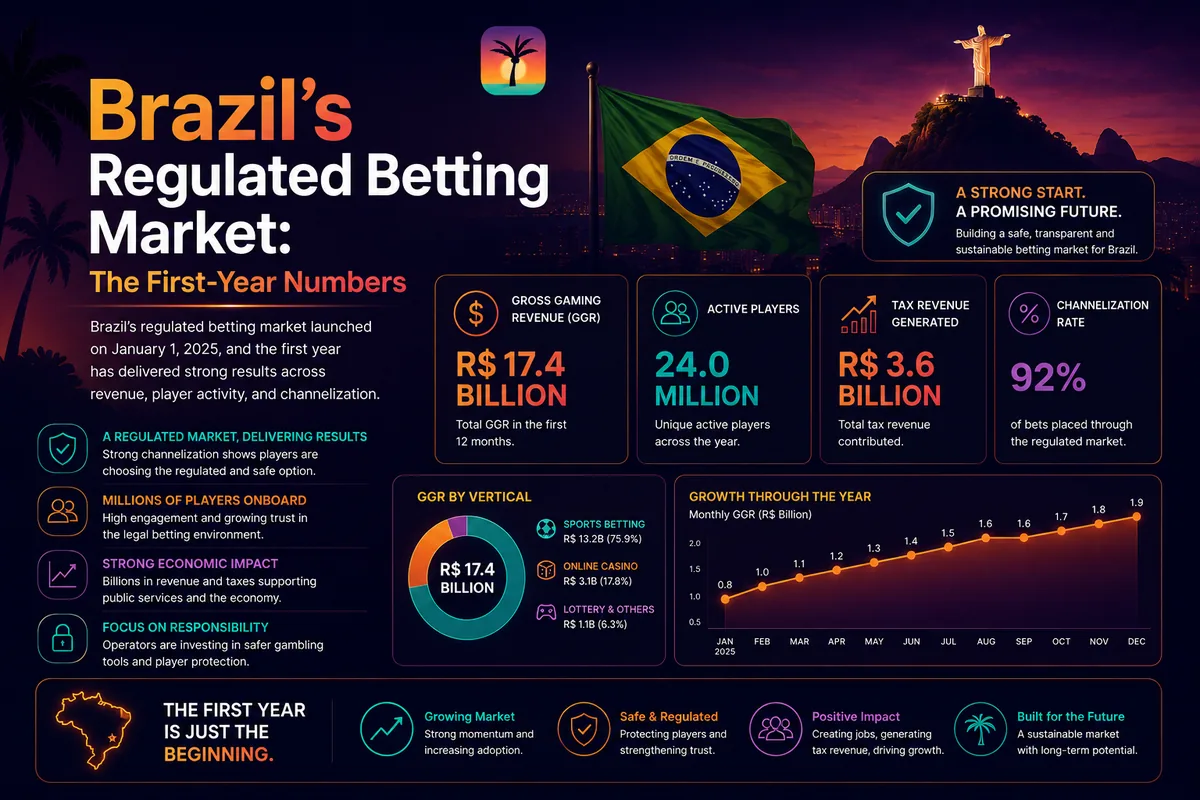
Here is the picture the first full year painted, with every figure framed as reported and approximate because official reconciliations lag the calendar. Volumes were large from the start. This was never a market being built from scratch; it was an existing grey market being formalised, so the licensed sites inherited millions of players who were already betting. Monthly wagering ran into the many billions of reais, and the government's tax take, while below the most optimistic early projections, arrived as a genuine new revenue line rather than a rounding error.
Channelisation is the number we care about most, because it measures whether regulation actually worked. Channelisation is the share of betting that happens on licensed sites rather than offshore. A high figure means players moved into the .bet.br system; a low one means the rules pushed play sideways instead of onshore. First-year reads put Brazil's channelisation encouragingly high by international standards, helped enormously by the .bet.br rule and the Pix payment blocking, which together made the licensed option both easy to identify and easy to use while making the offshore option harder to fund.
The caveats are real. High headline volumes also mean high spend, and a formalised market is still a market where people lose money, so the public-health scrutiny that followed the first year was entirely predictable. Some early operators failed to meet the standards and lost or never secured authorisation, thinning the field. And the offshore tail did not vanish; it shrank and went quieter. We would call year one a qualified success: the architecture works, the safety signal is genuinely useful, and the open questions are about enforcement stamina, not about whether the model was sound.
A player's checklist
Strip away the policy and here is what a Brazilian player actually needs to do, in order. Read the domain first: it must end in .bet.br, and you should read the true end of the address, not a lookalike fragment planted in the middle. If that check fails, nothing else matters, because you are already outside the protected system and outside any recourse the SPA can offer you.
Then check the money moves through your own Pix. Deposits and withdrawals should run through a Pix key tied to your own CPF, never to a stranger's account. Set a deposit limit before your first session, not after a bad one, and confirm the site actually offers self-exclusion and time-outs, because a licensed one must. Keep in mind that larger net winnings may be taxable, and keep your own record of what went in and what came out. And the line that sits under all of it: this is 18+ entertainment that costs money by design. Bet only what you can afford to lose, and if it stops being fun, use the tools the regime made every .bet.br site put in front of you.
Frequently asked questions
How do I know a Brazilian betting site is licensed?
Read the domain. Every operator authorised by the SPA must run its Brazilian site on a .bet.br address, so if the site does not end in .bet.br it is outside the regulated system. Watch for lookalike domains that plant a .bet.br-style fragment in the middle of the address; check the true end of the domain, the part right before the first slash.
Does the Brazilian licence cover online casino or just sports betting?
Both. The law regulates fixed-odds betting, and the SPA read that to include online casino games, so slots, live dealer and sports betting all sit under the same federal authorisation. One licence lets an operator run up to three brands, each on its own .bet.br domain.
Why is Pix used for almost everything?
Pix is Brazil's instant payment rail: free for individuals, settling in seconds at any hour, and used by nearly every adult. Deposits are instant and withdrawals can return in minutes. A regulator rule requires the paying and receiving account to belong to the same player, matched to their CPF, so your deposits and withdrawals should always run through your own Pix key.
Do I pay tax on my betting winnings in Brazil?
Winnings within the income-tax exemption band are generally not taxed, and net winnings above that threshold can be taxable at a reported rate of around 15 percent. The exact mechanics are still bedding in, so treat specific figures as approximate and check your current position. This is general information, not tax advice.
What happened to the offshore sites that used to serve Brazil?
The SPA blocked unlicensed domains and, more effectively, pressured payment providers to stop processing Pix and bank transfers for sites outside the .bet.br system. Choking the money is harder to evade than blocking a URL. The offshore tail shrank and went quieter rather than disappearing, and a site that suddenly cannot take your Pix is very likely one the system is shutting out.
Is the market working after its first year?
By the main measure that matters, channelisation, the share of betting on licensed rather than offshore sites, the first-year reads were encouragingly high by international standards, helped by the .bet.br rule and payment blocking. Volumes and tax revenue were substantial. The open questions are about enforcement stamina and gambling-harm oversight, not about whether the model itself was sound.
Want to see how we grade operators once we have opened an account, deposited our own money and timed the withdrawal? Our tested picks live on the top-rated casinos list. 18+ only. Read the domain, use your own Pix, set a deposit limit, and play responsibly.